

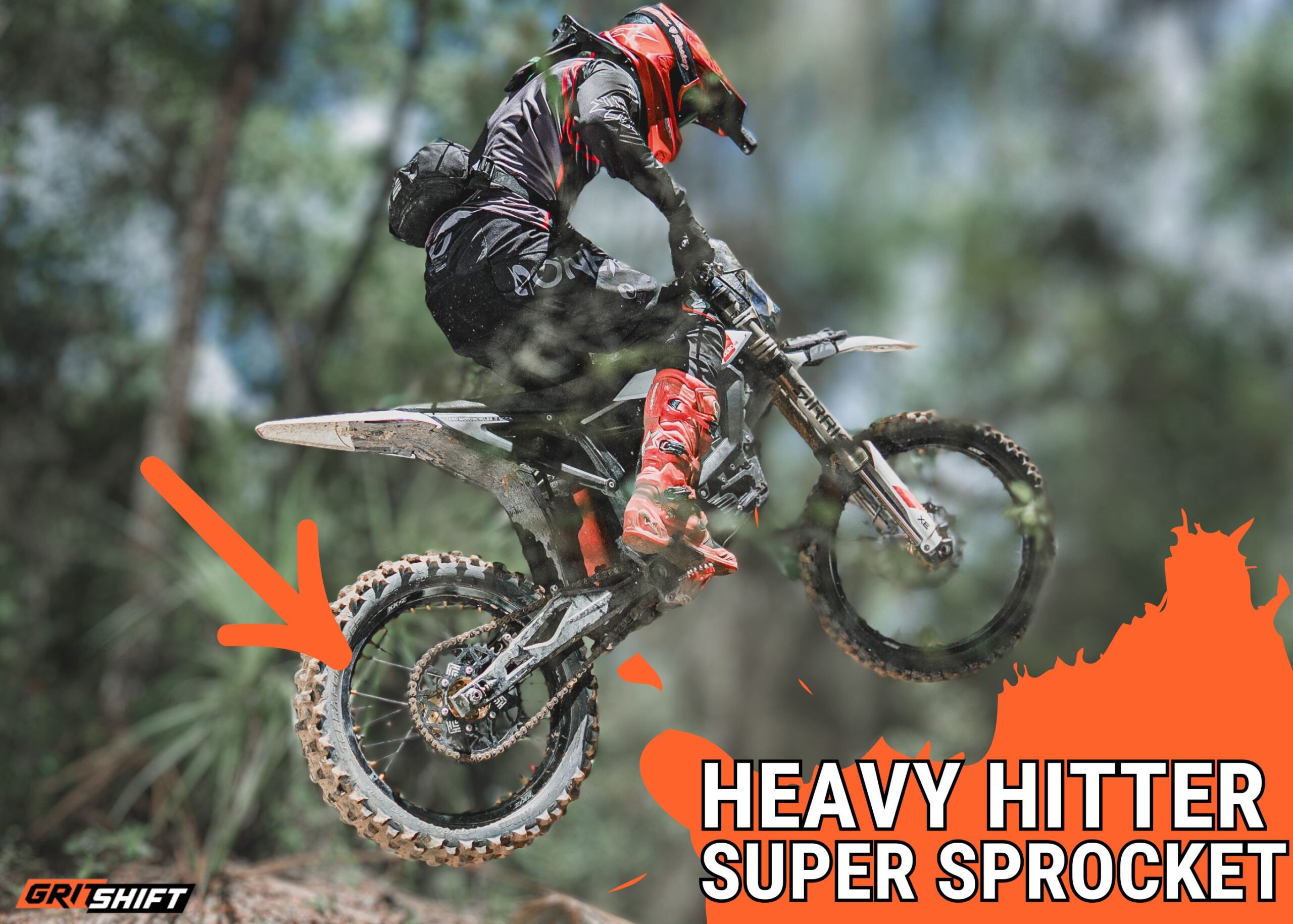

If you own a high-powered e-moto, this is a blog that you need to read. It’s about your sprocket. Have you upgraded it lately? Because if you’re running high power, either from a stock high-performance motor or an upgraded motor, you’re running the risk of that sprocket warping.
It doesn’t take much to realize what may happen if the sprocket bends – and if it does, it would likely be under load. Which means you’re accelerating, maybe out of a corner, maybe on a landing, and a bent sprocket equals a chain coming off. At the worst possible time.

We’ve seen it happen on our bikes and on our customers’ bikes, and we needed to work out a safe solution. This is the story about how and why we created the Heavy Hitter Super Sprocket.
The Heavy Hitter Super Sprocket
TLDR: Heavy Hitter has created a super strong sprocket that won’t warp under heavy load, compensating for the style of swingarm flex that’s unique to e-motos.
Currently, we have Super Sprockets in these variants:
Heavy Hitter 520 Ultra Bee Super Sprocket
Designed for the Surron Ultra Bee
Heavy Hitter 428 Billet Aluminum Super Sprocket
Designed for:
- E Ride Pro-SR
- E Ride Pro-SS 3.0
- Rawr Mantis X Pro (2024 to current)
Heavy Hitter 420 Billet Aluminum Super Sprocket
Designed for:
- Sur Ron LBX
- Segway X160 / X260
- Talaria Sting MX3 / MX4
- Talaria XXX
- E Ride Pro-S
- E Ride Pro-SS / 2.0
- Ventus ONE+
- 79Bike Falcon Pro / GT
- Rerode R1
- Rawr Mantis X / Pro (Pre 2024)
- Zero XB
The design flaw with many larger sprockets
Most sprockets – both stock and aftermarket – look awesome, but if you’re reading this, I’m guessing you’re like us and like practical over pretty. Although I must say, our R&D Lead, Rusty, does a great job in making practical things also look great!
The issue is that when you start using a sprocket from about a 52-tooth upwards, and you’re running high power (even stock high power!), the sprocket needs to be super tough to withstand the side load. E-motos amplify these forces through high torque which comes on instantly, which in turn brings out the weaknesses of basic gas-bike sprocket designs.
This includes many aftermarket big-name brand sprockets, which is a big reason why we needed to design our own. Yes, most of the products we have created come from us needing stronger parts on our own bikes.
Our business model is simple. We want to finish races, so if a part keeps stopping us from achieving that, we look at upgrading. If we can’t find anything that meets our quality criteria, we design it ourselves. We know that if we have found weak parts on our bikes, you probably will too. Our R&D team designs the part, we put it on our website, and then you can easily get a race-ready part!
Enough rambling, back to the sprockets… Rusty explains the warping phenomenon in this video:
Basically, as the chain runs over the top part of your sprocket, it creates a huge amount of force. This force is then transferred through the hub to turn the wheel. The distance between the outer part of the sprocket and the hub is the weak point. The thinner the design between the hub and the outer part of the sprocket, the more likely it is to bend. Obviously, this can also depend on the material the sprocket is made from, which is why we went with billet 7075-T6 aluminium for our Heavy Hitter Super Sprockets.

Other issues at play
We also need to chat about swingarm flex. In many mid-sized e-motos, the swing arm is known to have more flex than desired. We’ve seen this most prominently on the Surron LBX and the E Ride Pro lineup.
The combination of too much swing arm flex and a weak sprocket is further increasing the risk of a chain derailment. Rusty considered this swing arm flex in a very clever way when he was designing the Super Sprockets.
For the worst offenders, we have gone so far as to design our own swingarms.
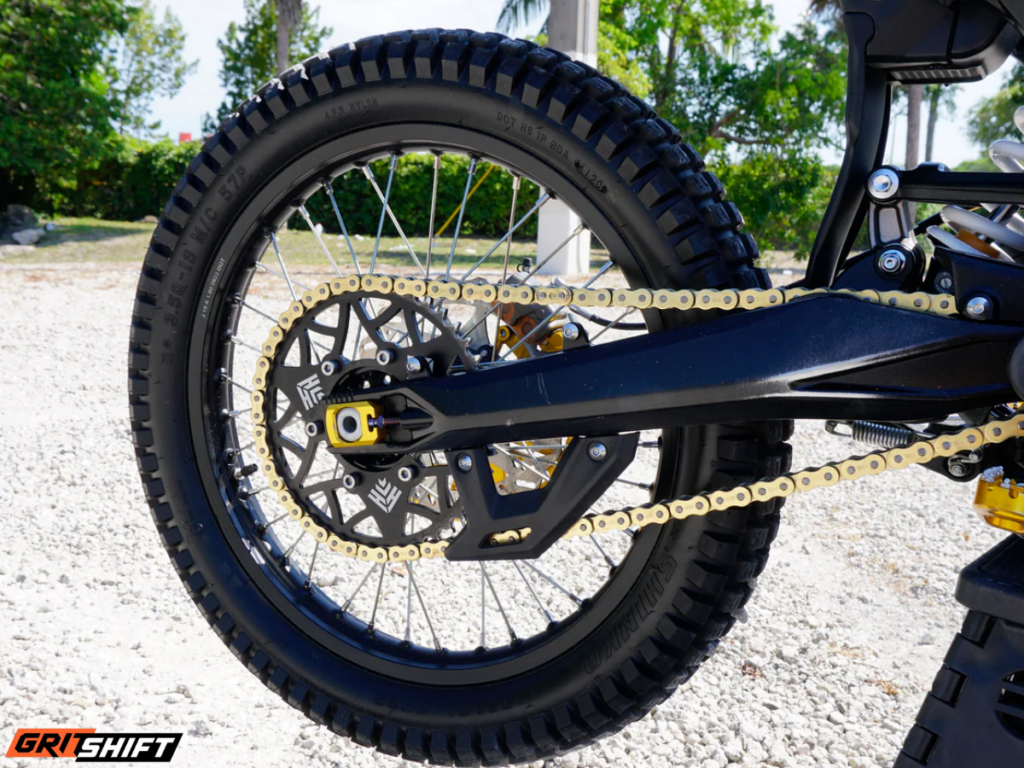
Not just a flashy design
When we first started seeing bent sprockets on our own bikes, we knew we needed to come up with a solution. We had tried many aftermarket sprockets, and that was when we started noticing some design flaws and knew we needed to re-engineer something.
Rusty and his team got to work and, by applying their knowledge of physics, came up with a design that allowed a more evenly distributed force. This process didn’t take as long as usual, as Rusty already had lots of failure data on many bent sprockets. Translation: Rusty had to push his bike so many times he decided to reinvent the sprocket!
Rusty went through about 4 rounds of iterations, mostly to refine the aesthetics and to see how much weight could be reduced. Billet Aluminium was the chosen material, precision-machined from one piece of 7075-T6 aluminium. If you’re interested in what 7075-T6 aluminium is and why we chose it, have a read of this skid plate
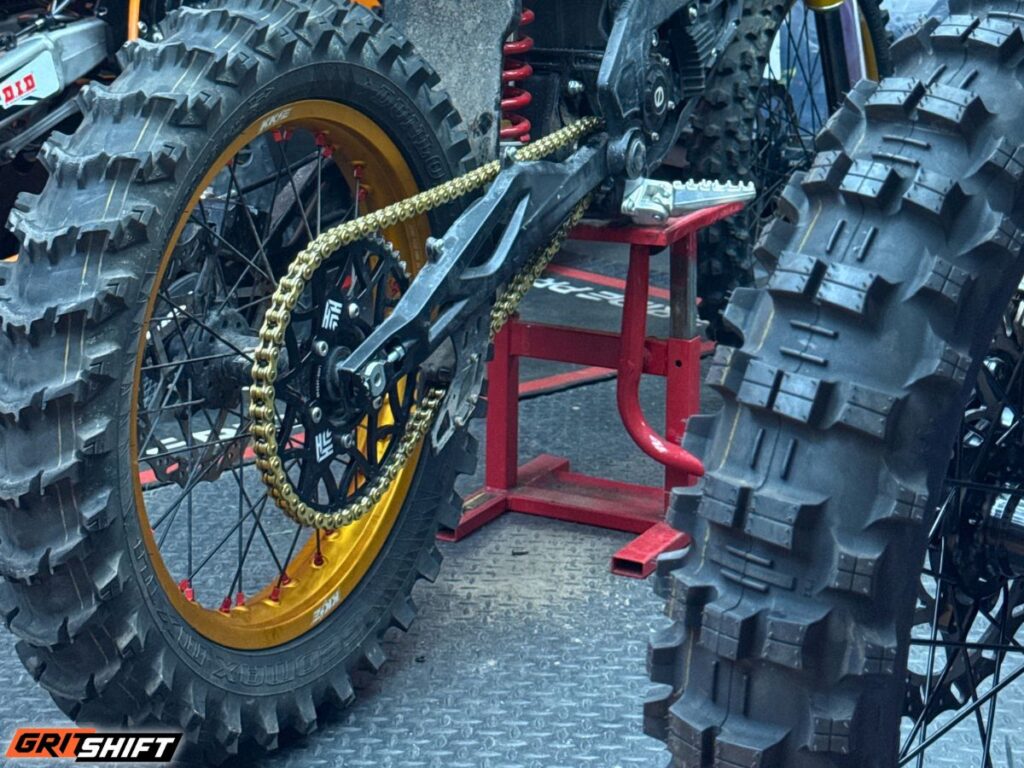
The Heavy Hitter Super Sprocket design creates strength towards the hub and adds points of connection along the outer part of the sprocket. It’s a fine balance of creating a light but strong sprocket. Many of the fancy-looking sprockets on the market have this in reverse. While those sprockets look great, I would keep them for lower power use. Not that ours are ugly!
Another aspect of this sprocket is the intricate design of the sprocket teeth. Rusty worked out the amount of typical swingarm flex in mid-sized e-motos, and he designed the teeth and ramp angle to allow for better contact between the sprocket and the chain. For those who love data, the tooth design is not a traditional ANSI tooth profile; it has been modified to draw maximum performance given the constraints of the flex. This means no wasted energy, smoother contact, easier for the chain to seat in the sprocket, and less wear.
Here is some further information about this design:
More about the testing phase
Once the prototype is created, it is then placed onto several of our team’s bikes so thorough testing takes place from a variety of riders and riding styles. After months of testing and refining, and more testing, on a per-bike basis, only then do we release these sprockets for sale.
If you’ve seen any of our Instagram posts, you’ll know we don’t test things lightly. We test to destruction. On purpose. And when Rusty designs something, this takes a lot of effort!! The reason we test to destruction is to find the weak points – and to make them even stronger. CAD simulations can only predict things to a certain level. Real-world hard riding will actually prove the parts.
BTW, jump onto our Instagram page to see this in action!
In particular, check out the posts with Rocket racing our highly modded Surron – named Grim – at the last moto event. He was running the Super Sprocket on Warp 9 wheels. Rocket rides hard, and during the event, he snapped the wheel hub. When we checked the sprocket, it was perfectly good. Maybe Rusty might need to look at making wheel hubs next?…. If you would like to see Heavy Hitter wheel hubs, send us an email!

Who needs one of these?
Anyone who rides an e-moto will benefit from one of these sprockets; they’re built to last. However, if you’re running high power, riding hard, and use a 52T sprocket or above, I highly recommend upgrading to this sprocket.
It’s a relatively cheap part compared to what you’d need to replace if a chain comes off. Especially if you’re mid-race!
If you have an E Ride Pro, it is also worth checking out the swing arm that Rusty and his team designed, to see if that might be worth considering.
For now, click here to read more on the Super Sprocket.
They’re available in both a 420 and a 428 size and will withstand whatever power is on your e-moto.




Leave a Reply