

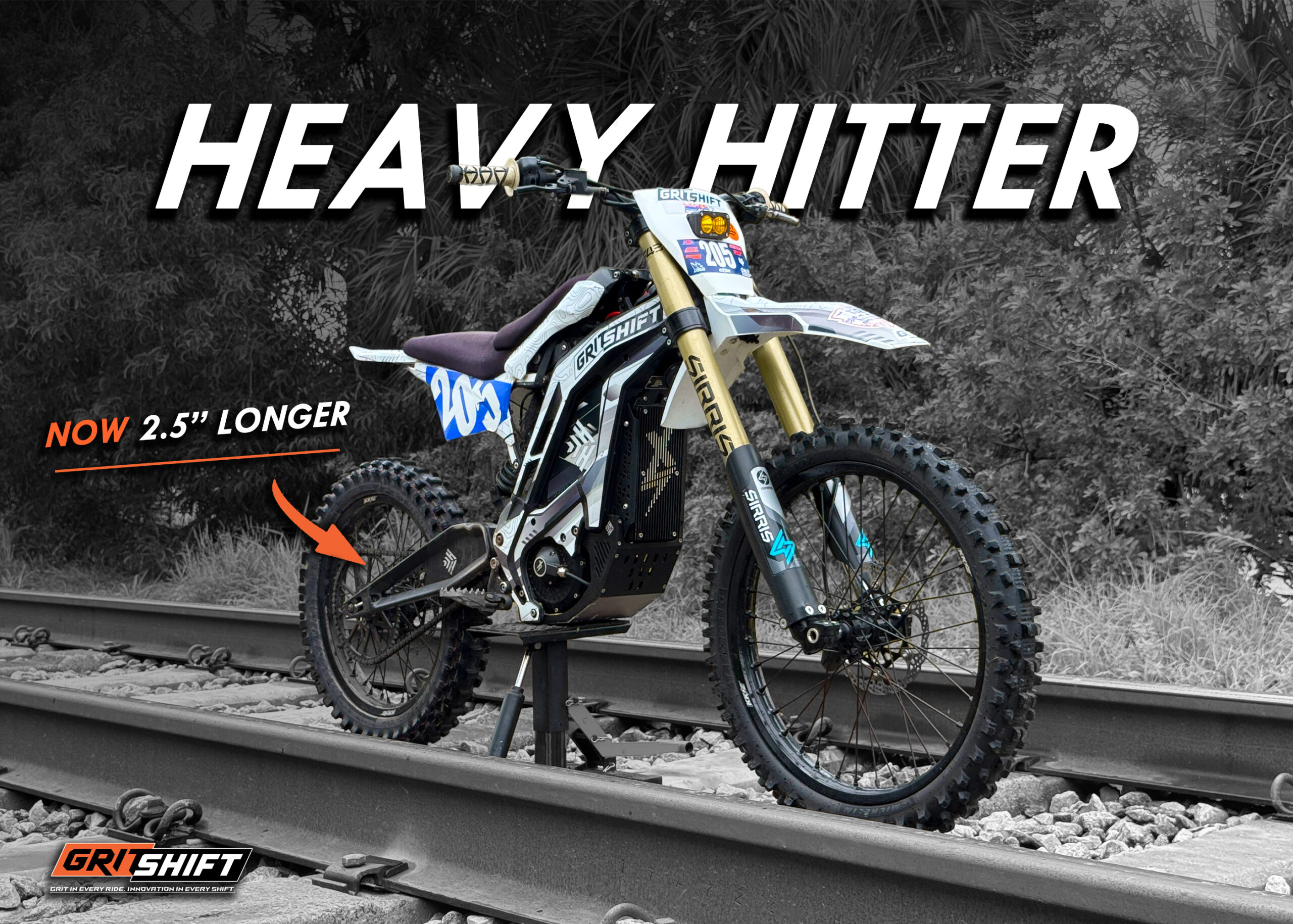

Swingarms on electric dirt bikes aren’t the most talked-about topic on the internet. You don’t hear all the big-name influencers describing how awesome their swing arm was, or wasn’t. I guess it just doesn’t have the same appeal as increasing the power or upgrading the suspension. But swingarms play a really huge role in the performance of your e-moto.
It is common knowledge that some e-moto brands have really flexible swing arms. While some flex in the swing arm and the chassis as a whole is needed to make the ride smoother, too much will have a detrimental effect. This effect ranges from an annoyance to a malfunction and damage to the motor.

The Heavy Hitter Rogue 2.5” Swingarm was born out of necessity. It was a part that our R&D Lead, Rusty, spent a very long time perfecting due to the complexities swing arms innately have and the improvements we felt the E Ride platform had room for. It took many variations to get this swing arm perfected, and here we are.
It started with a discouraging race weekend.
If you follow us on social media, you’ll know we’re massive fans of E Ride Pro. We’ve been authorised dealers for E Ride since their very beginning. They’re an awesome platform for everything the bike has been designed for. But the catch is, we like to ride them beyond what they’re designed for.
From motocross tracks and hard enduro competitions, to huge jumps and tall obstacles – when anything is taken beyond its limit, things start to break, and we have broken many E Rides.
One of the weak points on the E Ride is the swingarm. Well, there are a few e-motos that are in the same boat about a weaker swingarm. Under hard use, the stock swingarm flexes beyond the usual, and this can cause the chain to derail. It doesn’t take much to work out what happens if the chain comes off, especially in a high-load moment: Massive (expensive!) damage.
During one race a few years back, our team was competing on E Rides. At one point our CEO, Bullet, decided enough was enough and stopped racing that day due to repeated chain derailments on his E Ride Pro. It luckily didn’t cause much damage, but getting annoyed and losing trust in the bike put him in his head. It was frustrating and difficult to get back to race pace, so in the end he just gave up on the race altogether.
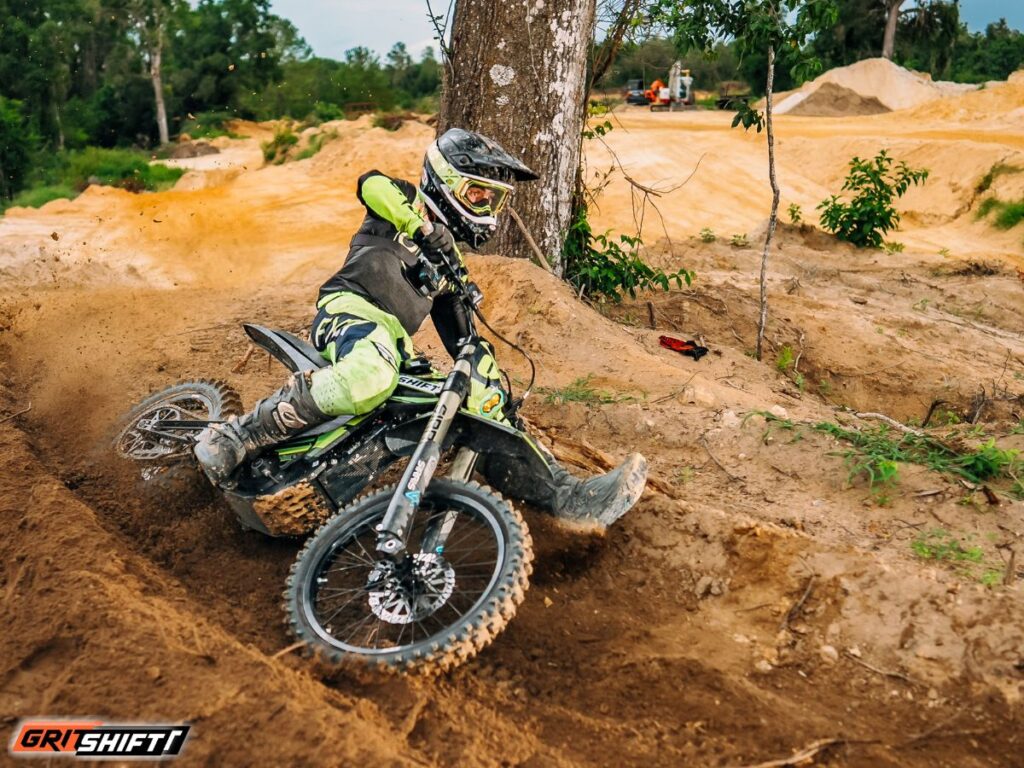
Bullet and Rusty soon got to work on designing a strong swingarm that would survive massive jumps, flat landings, and more importantly, make it to the end of races without losing the chain!
First, we got out the welder.
The first functional prototype was rudimentary and just a band-aid fix: taking an OEM swingarm and reinforcing it in critical areas. That got the bike going, but it wouldn’t work in the long run because welding aluminium without properly scorching it first can considerably weaken the material. It wasn’t long before they realised they needed to start from scratch.
Re-engineering one of the most complex components on the entire bike seemed intimidating at first, but Rusty and the team broke it down into steps and took it one step at a time.
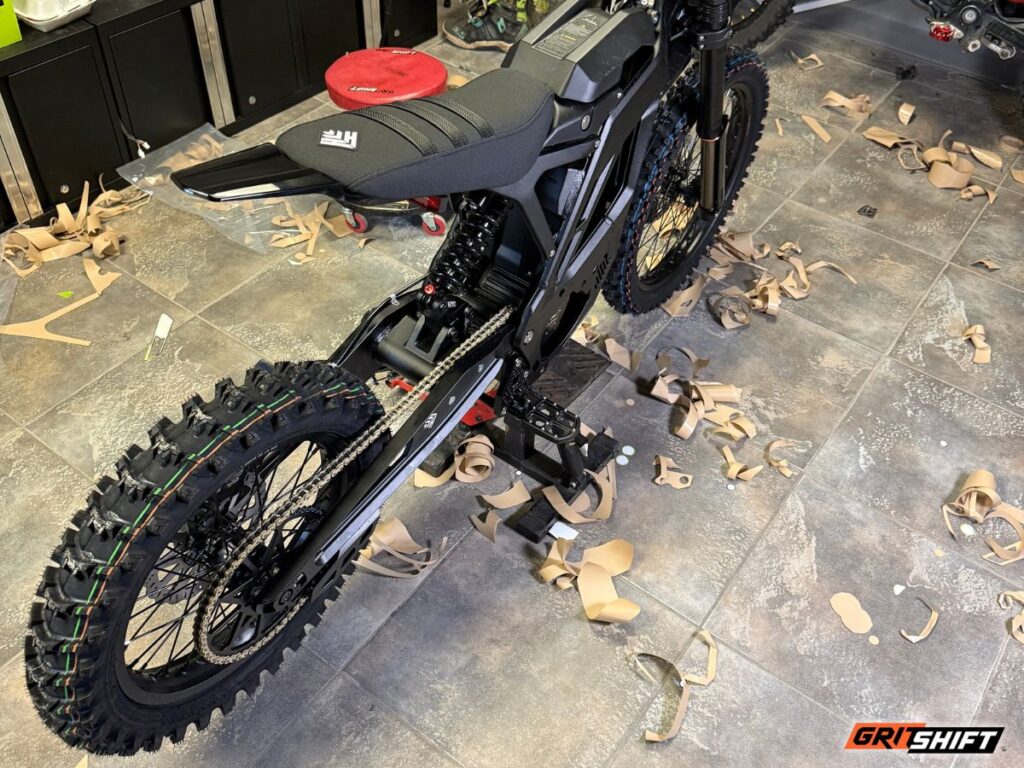
The chosen metal was 6061 aluminium. 7075 aluminum was considered, which is known for being “aircraft grade” but can become brittle under repeated cyclic stress – such as many hard landings over the course of many races. 6061 is easier to weld and has some innate flex to it.
Yes, I know I said the OEM swingarm’s flex was a problem – but that was too much flex. You need some flex in the metal so it can absorb the smaller bumps you get during the majority of riding time. All big-name brands incorporate some flex in their chassis. Honda, Kawasaki, KTM, they all have found the right amount of flex for what they want their bikes to be capable of doing. E Ride has too, but our goals are different from what E Ride wants to achieve with a stock bike. OEM parts are usually designed around typical everyday use, however we pretty much have one goal: competition-level performance and durability.
It all came down to length, not height.
The first fully designed swingarm prototype raised the rear of the bike by one inch. When Bullet went for the first test ride, he found it too unbalanced. The idea behind the one-inch rise was to allow clearance for an 18” rear rim when bottoming the suspension, but after additional testing, it didn’t take much to see this wasn’t worth the compromise in ride feel.
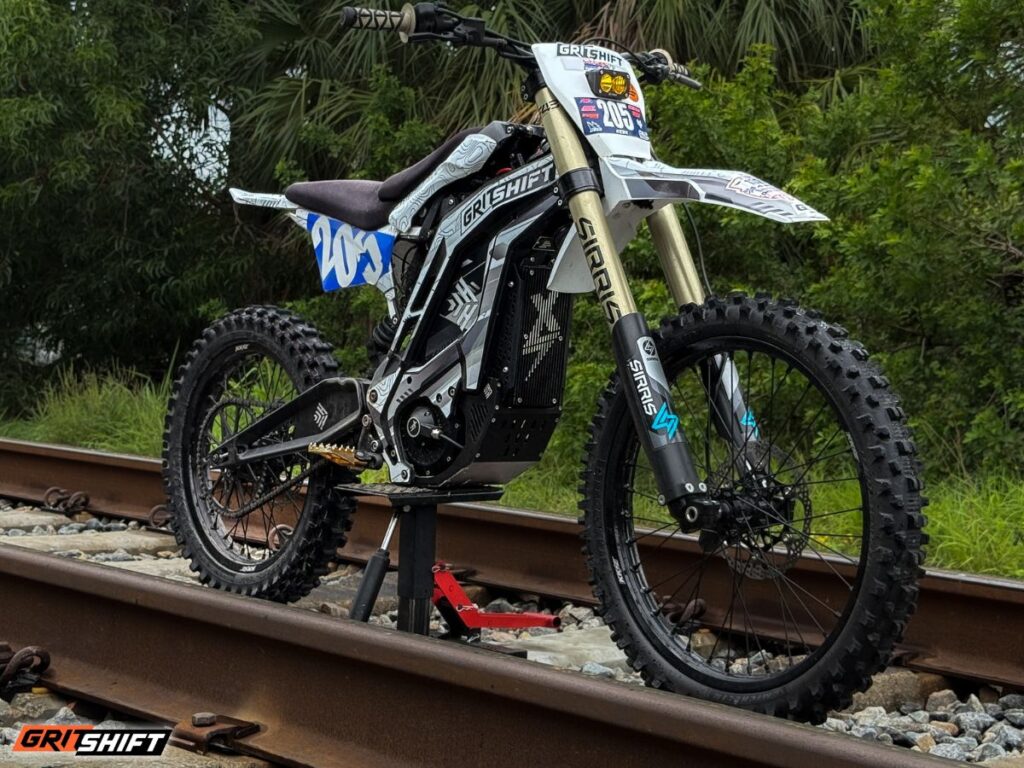
After more than 20 CAD designs and iterations, Rusty and his team settled on their preferred design.
- The swingarm itself was fundamentally redesigned from scratch.
- The needle bearings were completely redesigned to increase the static load rating per bearing to 6500 lbf, versus the OEM unit at 1030 lbf.
- The jackshaft retaining sleeve was upgraded to correct any bearing side load.
- The center cross support was lowered so the chain routes around it, a concept often seen in traditional MX swingarms.

Why 2.5 inches longer?
Easy. Everyone else was doing 2 inches!
For the longer version (so to speak) of the swingarm design, the increase in length increases stability, making the bike more comfortable to ride and bringing the wheelbase more in line with something like a Surron Ultra Bee. 2.5” was the number that Rusty and his team settled on after tons of testing and working out the safe length with regard to the rear shock.
The rear shock was the limiting factor of swingarm length. The longer the swingarm is, the more leverage ratio back to the shock, and during our design changes we discovered the safe working limits of the stock shaft and valving. At the time of production, there were very few larger-diameter shocks that would have been suitable, and that would also require people to buy a different shock and not just a swing arm.
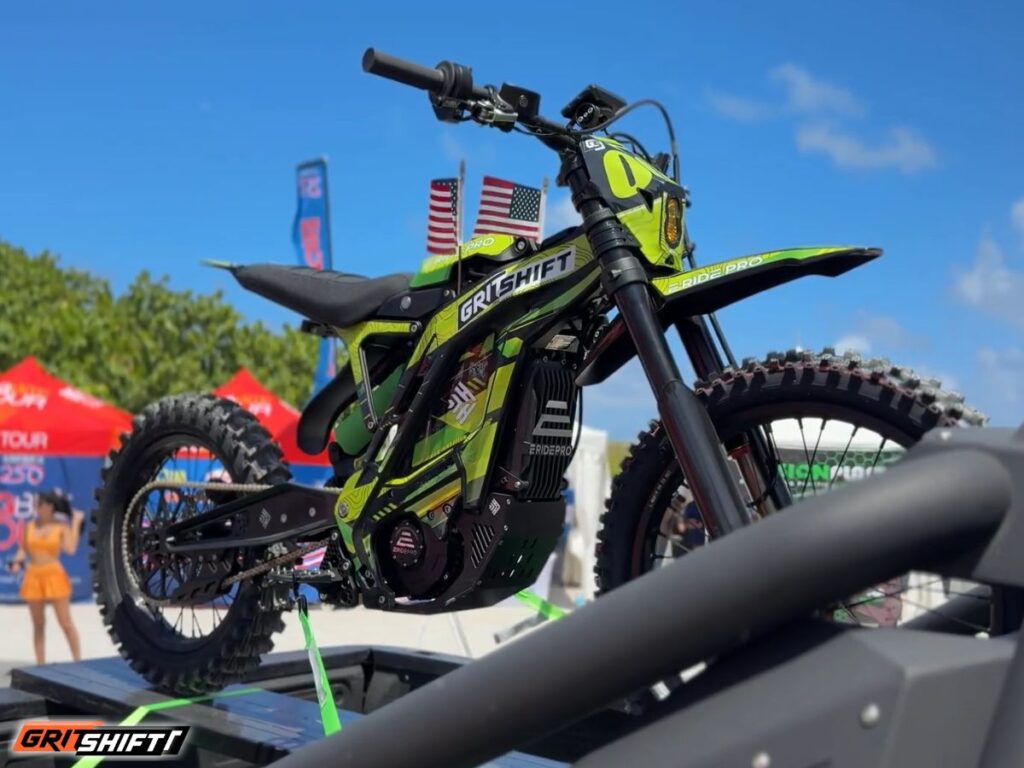
The final design ensures your stock shock will work just fine, but we strongly suggest adding our Heavy Hitter Adjustable Height Triangle to optimize the rear shock ratio with the change in articulation caused by the extended length.

Tech Specs
For the full range of specs, see this page but for a quick rundown, the specs are:
- Delrin Adjustable Chain Guide (48T – 58T)
- Steel Brake Bracket Pin (Please Apply Loctite)
- 10MM and 12MM Jackshaft/Swingarm Bearing Sleeves
- 2x Plastic Brake Line Retaining Clamps
- 1x Chromoly Linkage Bolt
- R/L Axle Block with Adjustment Bolt
We built what performs – and what we like.
After the initial prototype, there were numerous iterations before creating the design you see on our website today. Some broke, and others we just didn’t like.
Many of the design changes were based on performance changes observed on specific courses and during specific tests. Other times they were just plain subjective, coming down to what ride feel we preferred. But that’s what makes this our design and not someone else’s!
We’re proud of the final result. If you’re a rider who loves pushing the boundaries of what is possible on mid-sized e-motos, you will feel the unique character of this swing arm from the very first ride.
As a team of hardcore enthusiasts, our goals for components are different from E Ride’s as an OEM. E Ride Pro designs awesome bikes, but if you want to send them around MX tracks or compete as we do in enduro events, you can now ensure the stock E Ride swingarm doesn’t end your race.
It’s so good, even E Ride themselves took note.
When we competed in the EMR races out west, the official E Ride Pro team was also there. It was no surprise that they were also having issues with chain derailments due to swingarm flex and also clocking many DNFs. After seeing the success of our team bikes with the updated swingarm, E Ride asked for some assistance. At the end of the day, we’re all bike riders who love to get out and ride, so of course we helped.
We know the swingarm that Rusty and his team created is a successful high-performance part. We have reason to believe that E Ride was so impressed with the swingarm that the next batch of E Ride bikes released will sport a swingarm that will look remarkably similar to the Heavy Hitter Extended swingarm.
Watch this space, and in the meantime, get yourself a Heavy Hitter E Ride Pro Swing Arm and stop those day-ending chain derailments for good.




Leave a Reply