

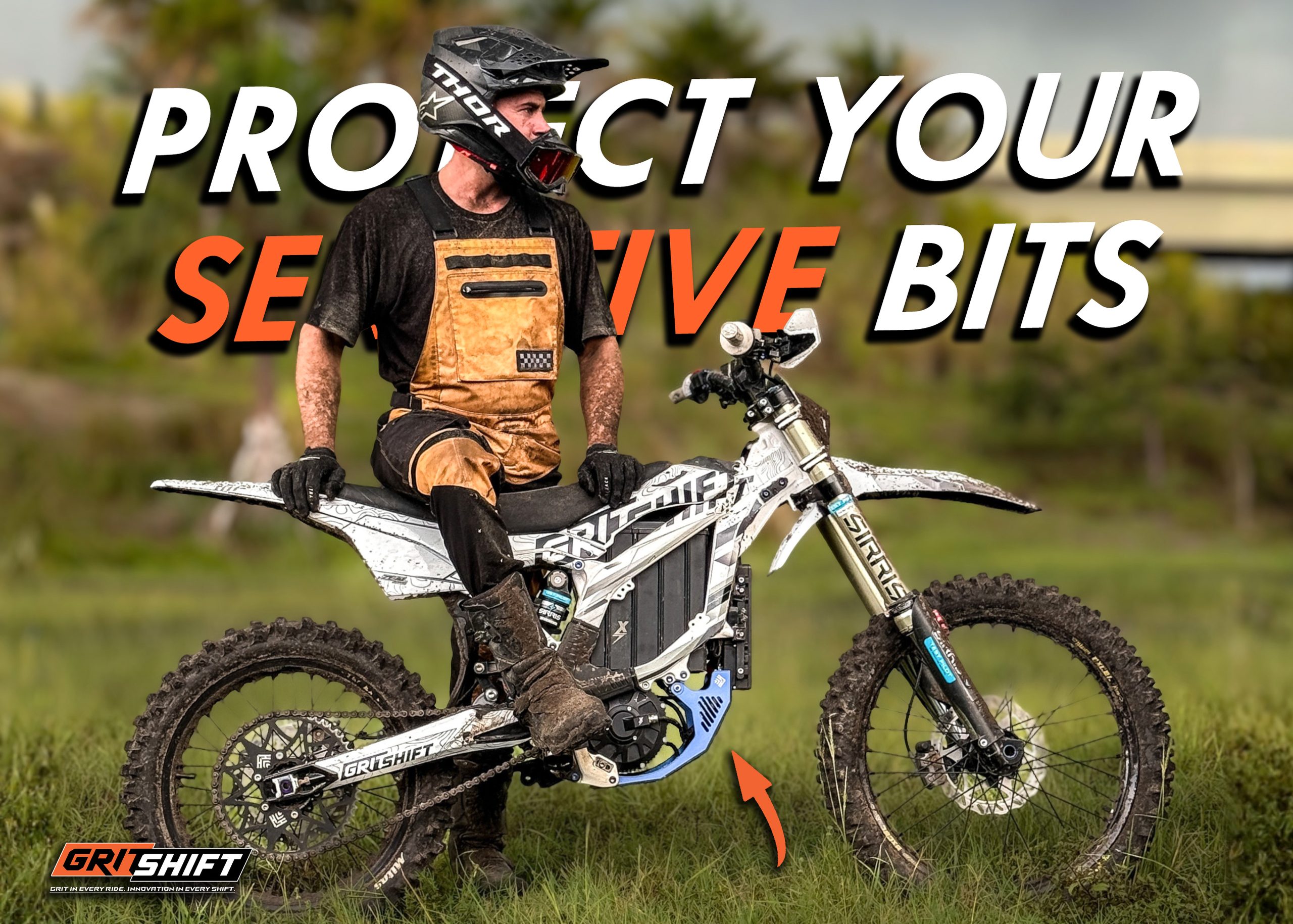

The skid plate could be the unsung hero of your electric dirt bike. Why? Because it sits there, under your bike, not doing anything until it’s needed. And when it’s needed, it will protect your expensive motor, controller, wires, and all that stuff that would be a huge pain – both mentally and financially – to replace!
But what makes a great skid plate? It’s simple really: put Rusty and his R&D team in a room and out will come a high-performance, race-ready skid plate!

The question then becomes, what type of skid plate do you need, and does everyone need one? What about the riders who love just exploring the urban streets? Let’s dive into everything about a skid plate and what I learnt from Rusty when I asked him all about skid plates!
Click to find out more:
What is a skid plate?
You’ve probably noticed stock e-moto skid plates are, well, flimsy. Good to protect the motor from fairy dust, but I wouldn’t trust it when it comes to riding through the woods. I’ve dragged my bikes more than once over logs and boulders, and without a sturdy skid plate, I would have done some serious damage.
However, if you’re riding a lightweight machine like the Surron LBX or E Ride Pro SS, you don’t want a huge chunk of armor adding weight to your bike. Sure, you need the protection, but not at the expense of solid weight gain.
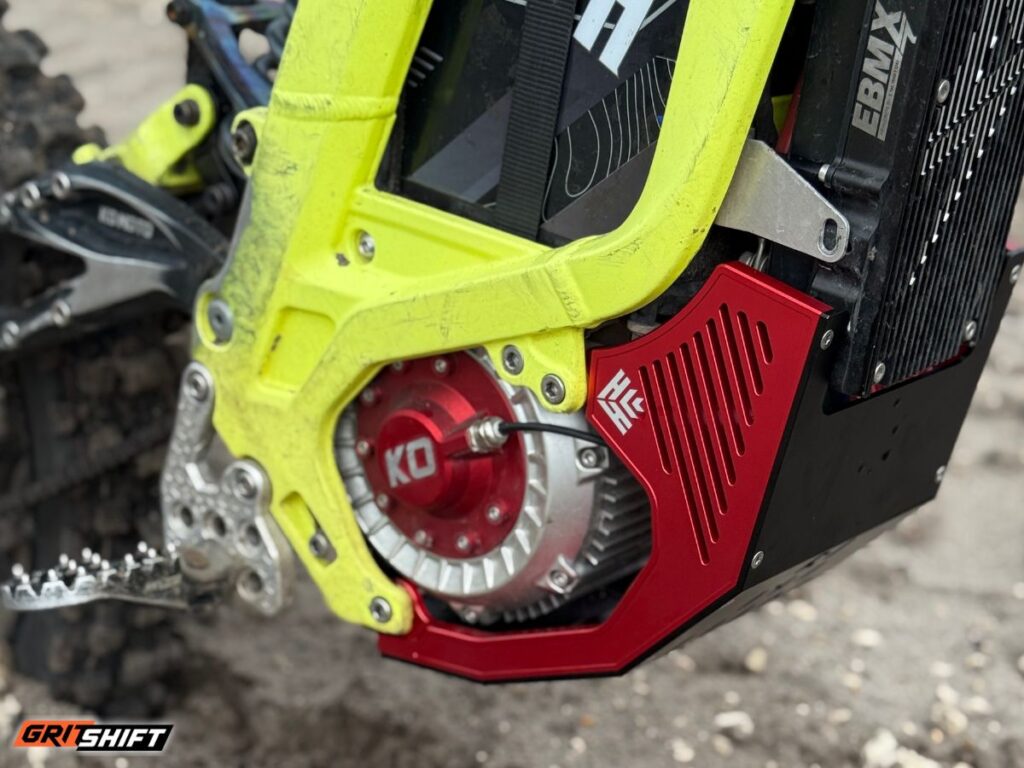
Our Heavy Hitter Skid Plates strike a balance of strength and weight, the result of clever designs and smart material choices. Rusty and his team have designed a few variations for different types of riding. For example, if you’re a rider who spends more time on the pavement or simple trails, our Nomad skid plate might be a better choice – it’s not as strong, but much lighter.
Skid plates are actually way more than a chunk of metal attached to the underside of your bike, let’s look at the science behind them!

Why did Heavy Hitter choose to design skid plates?
Like all of the products that we design in-house with Heavy Hitter, the skid plate came from necessity. We needed something that was:
- Tough enough to endure Hard Enduro racing weekend after weekend
- Light and airy, letting sufficient airflow through to avoid motor overheating
- Slick and angular to avoid hangups on logs, the toughest balancing act of all
When we were competing at our first Red Bull TKO events on e-motos, the only skid plates that were available at the time were some sort of plastic, similar to what is found in chopping boards. Either that, or OEM skid plates that were pretty useless.
So, what did we do? Designed our own!
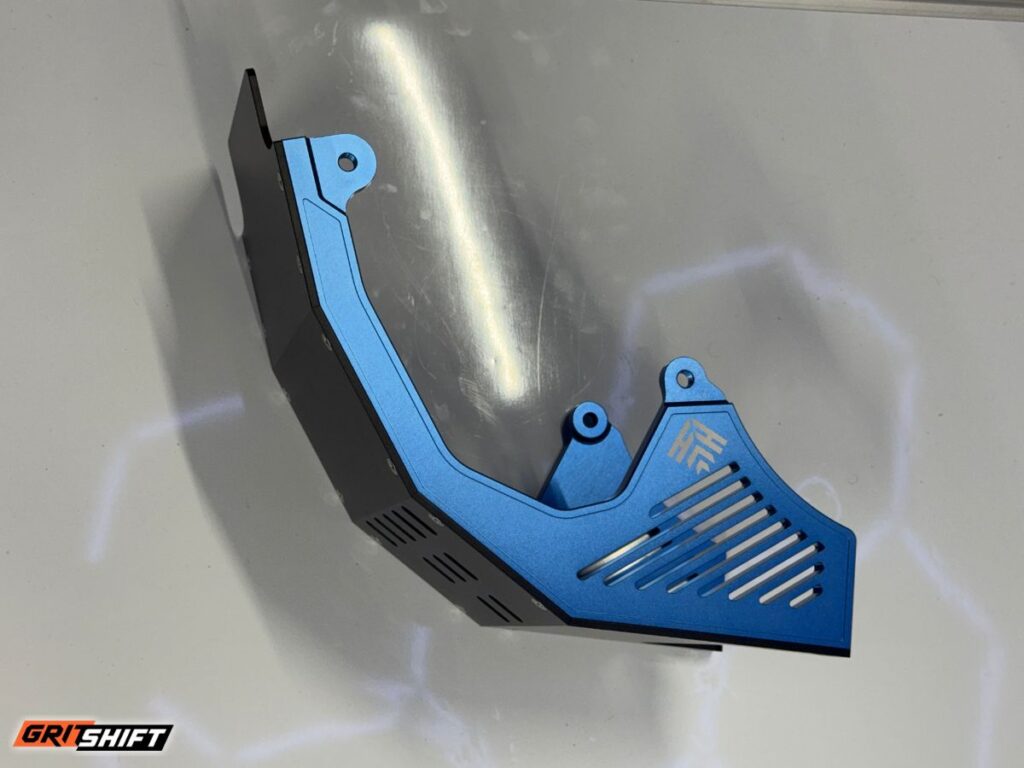
How we made our first Skid Plate
Our very first iteration, designed for the Surron LBX, was a two-plate design that was literally an L-shape. It worked, sort of. It got us through races, but we saw plenty of room for improvement, especially since it tended to snag on obstacles.
Rusty and his R&D team then developed a three-plate design to improve the angles. This went on to become the first production Heavy Hitter skid plate and one of our best-selling products of all time.
The material chosen was 7075-T6 billet aluminum, which is some pretty tough stuff; I’ll explain what 7075-T6 is shortly, as I found it interesting! The main bash plate is 10mm thick, and it’s easily replaceable if needed. The sides come in whatever color you like to match your style.
For more info on the color options, click here
The evolution of our Skid Plate
The V1.0 Skid Plate was relatively light, especially considering it could take the full brunt of boulders. But as we all know, the e-moto world is rapidly expanding, and technology is advancing, which means motors, phase wires, and just general configurations change with every generation.
The current version (V2.0) has many popular features from V1.0, and the design has adapted to fit newer e-motos. The Nomad skid plate V1.5 is a variant that helps keep weight down while still protecting better than an OEM skid plate. It isn’t as hardcore as our full skid plate, but it’s perfect if you mainly ride on pavement or gentle trails.
The technical specs
Here is where it gets really interesting. The material chosen was 7075-T6 billet aluminum. If you’re like me and don’t know the difference between aluminium and aluminium, here is what I found out.
7075 aluminium is an alloy with a composition that includes copper and zinc. T6 refers to the process of heat treating. Specifically, it means it is heated to about 900 degrees F, cooled, then reheated to about 250 degrees for 24 hours. Don’t ask me about the chemical technicalities, but due to some magic, this process allows the particles to form a super-high-strength alloy.
It has a high shear strength and is commonly referred to as ‘aircraft grade’ because it’s one of the highest-strength aluminum alloys available to use. Plus, it also has excellent corrosion resistance, making it ideal for the dirtiest place on any e-moto: the bottom.
Fun fact: 7075-T6 aluminium is used in spacecraft, defence applications, and aircraft!
What’s important with skid plates?
The perfect skid plate doesn’t just protect the motor, although it would be easy to think that. It also needs to allow airflow to keep the motor from overheating. No point needing a skid plate if the motor is contained within a hot box and goes into limp mode!
Anyway, it also needs to have a good angle to allow sliding over rocks and boulders, so strength without cracking or deforming is a must. And.. it needs to be lightweight. Strong and light normally don’t go together, so this is where Rusty and his team spend a lot of time and effort. You may need to remove the skid plate fairly often for routine maintenance, so easy on-off is a must.
Technical Specs for the Skid Plate

The Heavy Hitter Skid Plates
If you’re thinking of taking your bike off-road, I would highly recommend considering a skid plate. The OEM ones are pretty useless, and I wouldn’t trust them to withstand a solid boulder. Skid plates are like cheap insurance: put it on, forget about it, but be thankful that you have it when you’re dragging your bike over a big log!
As you can see, skid plates can start to get complicated during development! Rusty devised a number system on the Heavy Hitter Skid Plates to make fitment that is *almost* foolproof!
There are plenty of options from Heavy Hitter, V1.0 and V2.0 are available, along with V1.5, which is more for your everyday use on the street or some simple trail rides.
V1.5 is lightweight and will protect your motor, just not to the same extent as the heavy-duty options. This is known as the Nomad skid plate, have a closer look here.
My only suggestion, if you’re thinking about this, is to just click here to order one, as future you will be really annoyed if you’re sitting by the track with a busted motor after rolling over a boulder!




Leave a Reply