

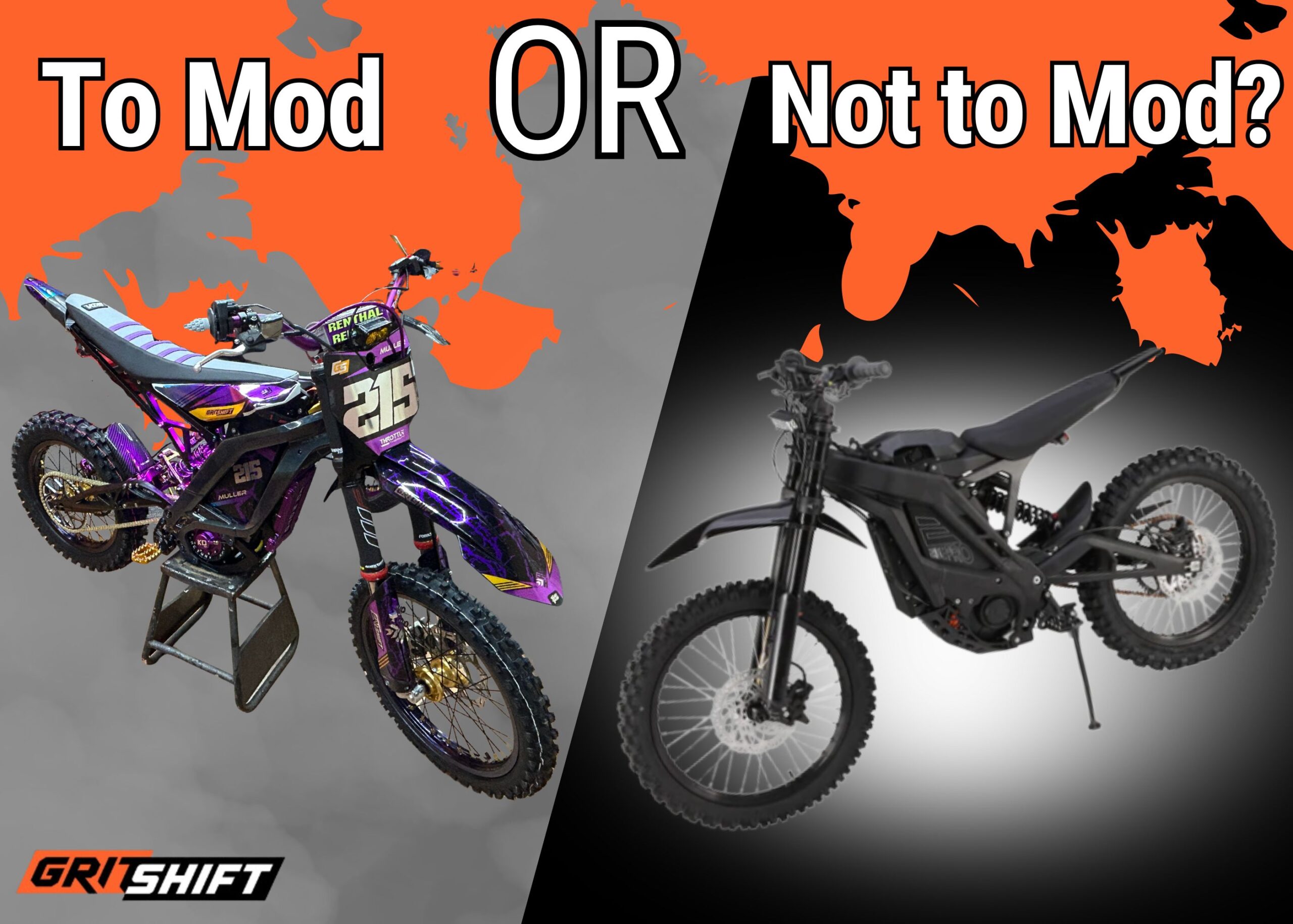

For a long time, the top performers of all up-and-coming e-moto brands ran 60 volt drivelines (60V). The poster child of midsize e-motos, Surron, ran 60V systems for years, and their main competitor, the Talaria Sting range, was made up of 60V bikes until the MX5 circa 2025.
60V was the magic number, and considering the midsize e-moto format was revolutionary in itself, 60V seemed like a huge amount of power. But as the world got used to it, people wanted more. Surrons and Talarias were modified with 72V systems, unleashing higher power output and greater performance – and to everyone’s surprise, the chassis could handle it with ease.
It soon became known that a 72 volt system gives the perfect amount of power and control without sacrificing flickability. The catch? A 72V conversion came at great expense to whoever did the modding. We’re talking thousands of dollars poured into what started as a $3000 or $4000 bike.

Well, why not make a 72V bike from the factory? And is buying a factory 72V e-moto a better plan than converting a 60V bike like a Surron LBX?
Let’s dive in.
Stock 72V Power? Who Does That?
E Ride Pro was the first company to bring a mid-sized e-moto to the mainstream with a 72V system from stock – a bike resembling a stock Surron LBX but with the performance potential of a heavily modded custom LBX.
Arctic Leopard followed suit, and even the old name Talaria got on the bandwagon with the 72V Sting MX5. Where was Surron during all that? Good question – who knows?
For the competition team at GritShift, we’ve been modding bikes to increase power for years, and one of the first things we would do is change the drivetrain to a 72V system. Being able to pick up a stock bike with 72 volts was the start of something new, and yet we still seek out good-quality 60V bikes to mod sometimes, because modding has its advantages.
So, which approach is better? Is buying a 72V e-moto the best way, or is it better to find a solid 60V bike and mod to your heart’s content?

Let’s explore the process, the costs involved, and which e-motos we would recommend for either a buy-and-ride today or a months-long modding adventure.
What Are The Advantages To Running 72 Volts?
TLDR: Amps produce heat. If you can lower the amount of amps, but increase the voltage, you can keep heat lower. In turn, you can increase the power without the heat issues.
Before we get into the nitty-gritty, if you’re new to e-moto, all this talk about different voltages might be foreign to you. If you already know, feel free to skip to the next chapter.
When you look at buying an e-moto, the main numbers that you’ll be faced with are voltage, amp hours, and watts.
In a simplified way,
- Voltage: Voltage is a term that describes how much ‘pressure’ pushes electricity. Higher voltages ‘push’ more electricity flow into an electronic device. Think of electricity as a stream. It will flow from a place of higher pressure to a place of lower pressure, much like a stream flowing from the top of a mountain to the bottom. You could replace the word flow with ‘current’ and voltage could be the potential energy ‘pushing’ it downstream.
- Amp Hours: Amps are how you measure how big the stream of electricity is. It is how much current is flowing through your electrical circuit. Think of the water inside a large-diameter hose vs. a small-diameter hose.
- Watts: A Watt is how you measure the power. You can work out Watts by calculating Amps x Volts.
Remember this equation: Watts = Amps x Voltage
Heat is not good. 72V reduces heat.
Now for the part that is directly relevant to e-moto. Amps produce heat. The more amps, the more heat. Too much heat stops motors from working at full power. Most bikes have an automatic ‘limp’ mode that limits the power to avoid damaging the components. So, the lower you can keep the amps, the more power you can produce for the same amount of output.
If you’re not keen on maths, that equation of Watts = Amps x Voltage means if you times amps by the voltage, you can get the wattage. On the other hand, if you increase the voltage, you can lower the amps for the same amount of watts.
Here is an article I wrote about 60v vs 72v if you want to dive deeper:
And if you want even more technical info (not necessary to ride, but for those interested), here is a great site: https://www.mathsisfun.com/physics/electric-power.html
So just go 72V from the factory, right?
Now you have an idea why 72V is preferred over 60V, you may be thinking, It’s obvious – just get a 72V e-moto. But, like everything in life, it’s more complicated than that!
60V e-motos are generally cheaper to buy, and many riders will find the extra power that 72V e-motos can provide isn’t really needed. We’re not your parents, so “want versus need” isn’t where this is going, don’t worry!
If you do want or need that extra power for your preferred riding style, then there are two paths that you can venture down:
- Buy a 60V e-moto, then mod the powertrain, and anything else you need to produce a completed customized e-moto, or
- Buy a 72V e-moto, perfect for most things right from the beginning, and simply make slight mods to it to customize it to your liking.
To keep things simple, let’s look at some of our favourite 72 volt e-motos, then I’ll walk you through the process to mod our favourite 60V e-motos for a comparison.
Best Factory 72V E-Motos Available Now
(Prices throughout this blog are accurate at the time of writing. Please check our parts site for the current price)
E-Ride Pro SS (2.0 / 3.0 / SR)
E Ride Pro is one of our favourite brands here at GritShift. Many of us brought the original E Ride Pro, the SS 1.0, when it was first released – long before we became official dealers of the brand. Since then, many of us have bought a selection of different model E Ride Pro e-motos, and we’re using the Surrons and Talarias less and less.
Here is a quick rundown of the specs.
E Ride Pro SS 2.0
- 72V 40Ah battery with 12kW peak power
- Top Speed: 60mph
- 0-30 mph: 2.36 seconds
- Tire Size: 19/18”
- Price: $5,099
E Ride Pro SS 3.0
- 72V 50Ah battery with 15.8kW peak power
- Top Speed: 62mph
- 0-30mph: 2.0 seconds
- Tire Size: 19/18”
- Price: $5,799
E Ride Pro SR
- 72V 50Ah battery with 25kW peak power
- Top Speed: 70mph
- 0-30mph: 1.8 seconds
- Tire Size: 19/18”
- Price: $6,499
With a few options to choose from, there is an e-moto here for all experience levels. Honestly, all the E Ride Pro bikes are fast. Look at the acceleration! Even on the SS 2.0, the 0-30 time is just a little over 2 seconds.
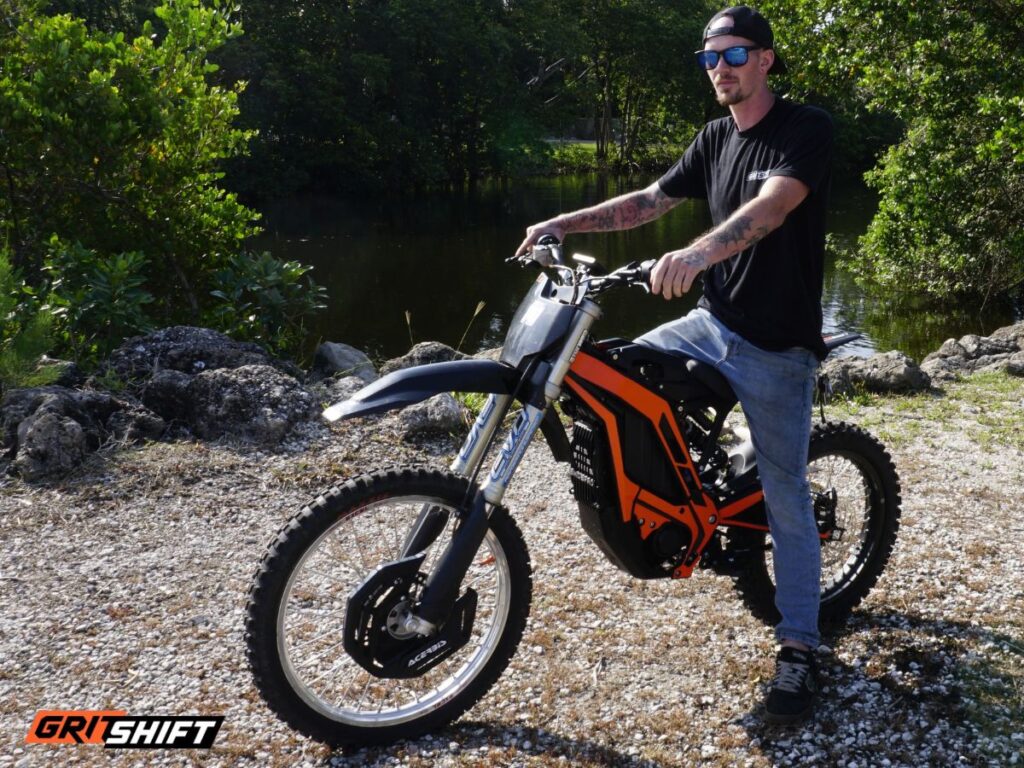
E Ride Pro models range between $5,000 and $6,500, depending on model, and as you’ll see shortly, this is cheaper than a new Surron with similar performance customizations.
Arctic Leopard XE Pro S
The Arctic Leopard XE Pro S is a factory 20kW e-moto that, unlike a Surron LBX or E Ride, is a full-size dirt bike. With standard dirt bike wheel sizes – 21” on the front, 18” on the rear – this is more of your Honda 450 replacement than a Surron-style small e-moto. But as long as you’re tall enough, that’s no problem.
Arctic Leopard XE Pro S
- 72V 55Ah battery with 20kW peak power
- Top Speed: 62mph
- Tire Size: 21/18”
- Price: $5,899
From the factory, the XE Pro S is capable of 62mph, and if you want to customize it further, we offer plenty of aftermarket parts to help your modding journey.
“The Arctic Leopard XE Pro S is hands down the best midsize Moto you can buy.” Team Rider, Rocket.
He goes on to say:
“Literally no upgrades are needed. Even the brakes got my approval. The day I got on my bike I was able to go shred with all my buddies who have modified Surrons and modified E Ride Pro’s. Not to mention the battery range is unmatched. All around a very impressive bike that holds the #1 spot in my opinion.”
Ventus One Plus
Ventus One is a company that hasn’t really taken off in the same way E Ride Pro or Arctic Leopard have. With only one model currently released, the Ventus One Plus, they are singularly focused on catering to the rider who wants more speed and power – their only bike is a stock 72V powertrain, which says a lot about their goals.
Ventus One Plus
- 72V 50Ah battery with 28kW peak power
- Top Speed: 81mph
- Tire Size: 19/18”
- Price: $6,399
The Ventus One Plus has an impressive top speed of 81mph from a 28kW peak power. The price is more than the Surron LBX, more on par with the E Ride Pro SR, but it seems to be great value for money if top speed is what you’re looking for.
As a team, we haven’t had a huge amount of time with the Ventus One Plus just yet. We have enough experience to say that it seems like a good contender, but the big thing we don’t know about is longevity – how it will withstand long-term abuse. We want to figure that out before giving it our whole-hearted endorsement.
And, we’re going to find out. Be sure to subscribe to our newsletter to be the first to hear about this and other e-moto news for years to come.

If you already have a Ventus One Plus and have the itch to mod, check out the GritShift parts and accessories range here:
Upgrading the Surron LBX to 72V – Why or Why Not?
Now that you’ve seen some great factory 72V e-motos, let’s focus on the factory 60V Surron LBX. Prior to any upgrades, a stock Surron LBX can achieve around 47mph from a 60V 40Ah battery, yielding a 0-31 time of 2.7 seconds. Retail price is around $5,000, and all told, it’s one of our favorite 60V e-motos to start a build on.
What do I mean by “start” – and do you really need to upgrade an LBX?
No, not necessarily. If you are a rider who doesn’t feel the urge to ride hard all the time, a stock Surron LBX could be the perfect bike for you right from the factory, and no mods would be needed if you don’t want to push the envelope.
However, if you do want to push the limits – which is fine by us – the Surron frame is sturdy enough to handle 72V power. The chassis has a great feel and predictability to it, something Surron got correct from day one, and even years later some of us at GritShift still think it’s one of the best-riding electric dirt bikes you can buy – and it’s even better with 72V of punch.
What Needs to Be Upgraded To Run 72V?
To bring the Surron LBX up to spec with the factory 72V e-motos, let’s compare it with something like the E Ride Pro SR. It’s crazy fast, strong, and can withstand just about anything.
This is the minimum you’ll want to look at upgrading, with suggestions included and the price, which is accurate at the time of writing. Check the link for the up-to-date prices.
| Controller | EBMX X9000 V3 | $1,200 | View Here |
| Motor | EBMX XLB-60 Core | $1,000 | View Here |
| Battery | Chi | $1,600 | View Here |
| Forks | Sirris F43 CMX Fork Upgrade | $2,250 | View Here |
| Rear suspension | Vonkat TENfive V2 Rear Shock | $700 | View Here |
| Linkage and Triangle | Heavy Hitter | $389 + $349 | View Triangle View Linkage |
| Brakes | Hayes Dominion A4 Brake Kit | $249 | View Here |
| TOTAL COST | = $7,737 |
Fully modifying a stock Surron LBX to handle 72v power will cost you around $7,700. This is more expensive than buying a stock 72v midsize bike like an E Ride Pro SR or even the full-size Ventus One Plus.
As we all know, modding can be a never-ending journey. You can add parts like sprocket upgrades, tires, rims, new chain, handlebars, and more, but I wanted to keep this list to a minimum to compare with the E Ride Pro SR.
Check out this article if you want to find out more about modding the E Ride Pro SR.
Additionally, you can add extra parts to the E Ride Pro SR to customize it to your liking, so this is where things start to overlap. The list above is the minimum you would need to get the equivalent power, and then to strengthen the components like the suspension and linkages to safely handle the bigger power. I guess you could mod the powertrain without improving brakes or suspension, but you’re definitely going to break stuff.
So, why would you mod instead? Well, the real questions are how much your time is worth, and what you want the end product to become.
Comparing a 72V Build to a Stock 72v Bike
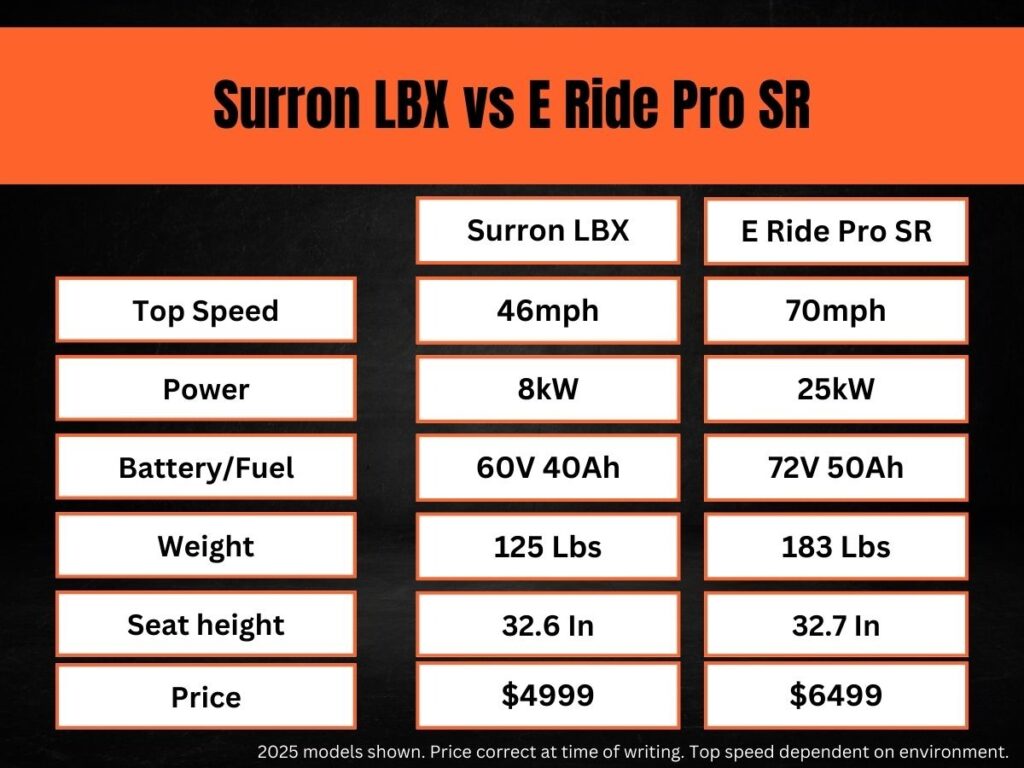
As you can see from these statistics, you can’t really compare a stock Surron LBX to the E Ride Pro SR. They are 2 different bikes. However, if you choose to get yourself a Surron LBX and mod it to the specs of the SR, that’s a different story. You could potentially build yourself a much more powerful, flickable, exciting ride.
There is just one catch. Maybe 2. Firstly, on top of the price of the bike, you’ll also need to spend around $7700 more to safely bring the LBX up to SR specs. You’ll also need time and some knowledge of how to mod. Anyone can learn, there is so much information on our blog and others on the internet; you’ll work it out, but it’s still time consuming.
Some say that’s part of the process, and they really enjoy the build. Others just want to get out and ride. It’s completely up to you.
Can you upgrade for cheaper?
You could also look at just upgrading the powertrain – the battery, motor and controller. This might be OK if you’re careful on the brakes, but stock Surron brakes suck at the best of times even with stock power, let alone trying to pull up from crazy speeds, you’ll easily cook your brakes and get instant brake fade. This is not advisable but I suppose you could do it temporarily while you save up for brakes.
The other issue with only upgrading the powertrain is the temptation to test out your new build on jumps. The stock suspension is OK for most riders, but add in more power, and you’ll likely be a more experienced rider and will outride the capabilities of the stock components.
Can you buy a used bike cheaper?
If you’re someone who could take or leave the building process, it is possible to do this all for even cheaper by buying a second hand bike that’s already modded. You may find the exact thing you were going to build, but a lot cheaper.
The obvious drawback is you are at the mercy of whoever did the mods in the first place. You will want to go over everything they did, which will take as long as doing it yourself but will still end up being cheaper.
Again, what is your time worth? How much do you trust a random Marketplace seller? Do you know the signs to look for – overheating, poor installations, knackered wiring?
Check out this article on purchasing secondhand bikes to learn what red flags to look for.
What’s Best? Modding or Buying?
As we’ve learned here, there are really three options.
Answer: Buy a stock 72v e-moto. This is you if you already know you want to ride hard, you don’t really get too picky about the specifics of what the controller or motor are capable of, and you don’t care about modding for looks or appearances, you just want to go out and rip. Get a stock 72V bike and then think about any potential ergo/handling/comfort mods as you need.
Answer: Mod a stock 60V e-moto. This is you if you’re the kind to want knowledge and control over every little variable, if you think you might want to fine-tune the performance of your machine over the course of months or years, or if you just like the journey of building something custom that nobody else has. Get a 60V Surron LBX or Talaria Sting and mod away!
Answer: Buy a used bike that’s already converted. This one’s for the brave, the experienced, the tinkerers, the shop owners, or anyone else who feels confident buying someone else’s project. You’re putting your life in the hands of some random person off Marketplace, but if you know how everything works and you’re handy with a wrench, you could save thousands off the price of building or buying the same level of performance brand new.
What is your time worth? Do you like building? Do you trust random people? We know what we would do, but we’re professional competition-level riders and bike builders, so our opinions might not mean much here, but let’s close with that.

What Would a Pro Do?
Most of the members of the GritShift team are professional riders, competitors, and bike builders. We don’t leave anything stock – even high-dollar bikes like the Ventus One Plus and E Ride Pro SR go under the scalpel when we inevitably find something we could improve to suit our tastes and needs.
With that said, there are plenty of stock e-bikes floating around GritShift HQ. They run to the gas station for a Red Bull, they ride to the beach for lunch, and they get us home from work after a long day. There’s nothing wrong with a stock Surron, Talaria, or any of that. It all comes down to what your goals are and what you want to achieve.
When it comes to e-motos, there is no right or wrong way of doing anything. Some ways might be more expensive, others might take more time, but if you enjoy the process and can get out and ride at the end, you have a winner. Think about what is more important to you.
The purpose of our blog is to help you draw your own conclusions; we’re all experienced riders with a diverse background of racing, weekend warrior, pro, in all sorts of disciplines, and you’re welcome here regardless of what e-moto you have. Check out our other articles to learn more about the modding and buying process, and we’ll see you on the trails!
Leave a Reply